Knitted flat, then cut.
Everything here begins as a roll of fabric. A sweater does not: it is knitted to shape, panel by panel, on a different machine. That single difference explains why plain jersey drapes rather than holds, why it shrinks in length more than in width, and why it belongs underneath.
21 distinct fabric weights in the catalogue, from 140 to 960 g/m².
Eighty grams is the whole argument.
Between 140 and 220 g/m² a plain jersey stops being translucent, stops clinging, starts holding a shape and starts surviving a second winter. Nothing else about the fabric — not the fibre, not the finish — moves the result as far.
Three structures, three behaviours.
All three are jersey — knitted as fabric on a circular machine — but the arrangement of the loops changes what the finished piece does on the body.
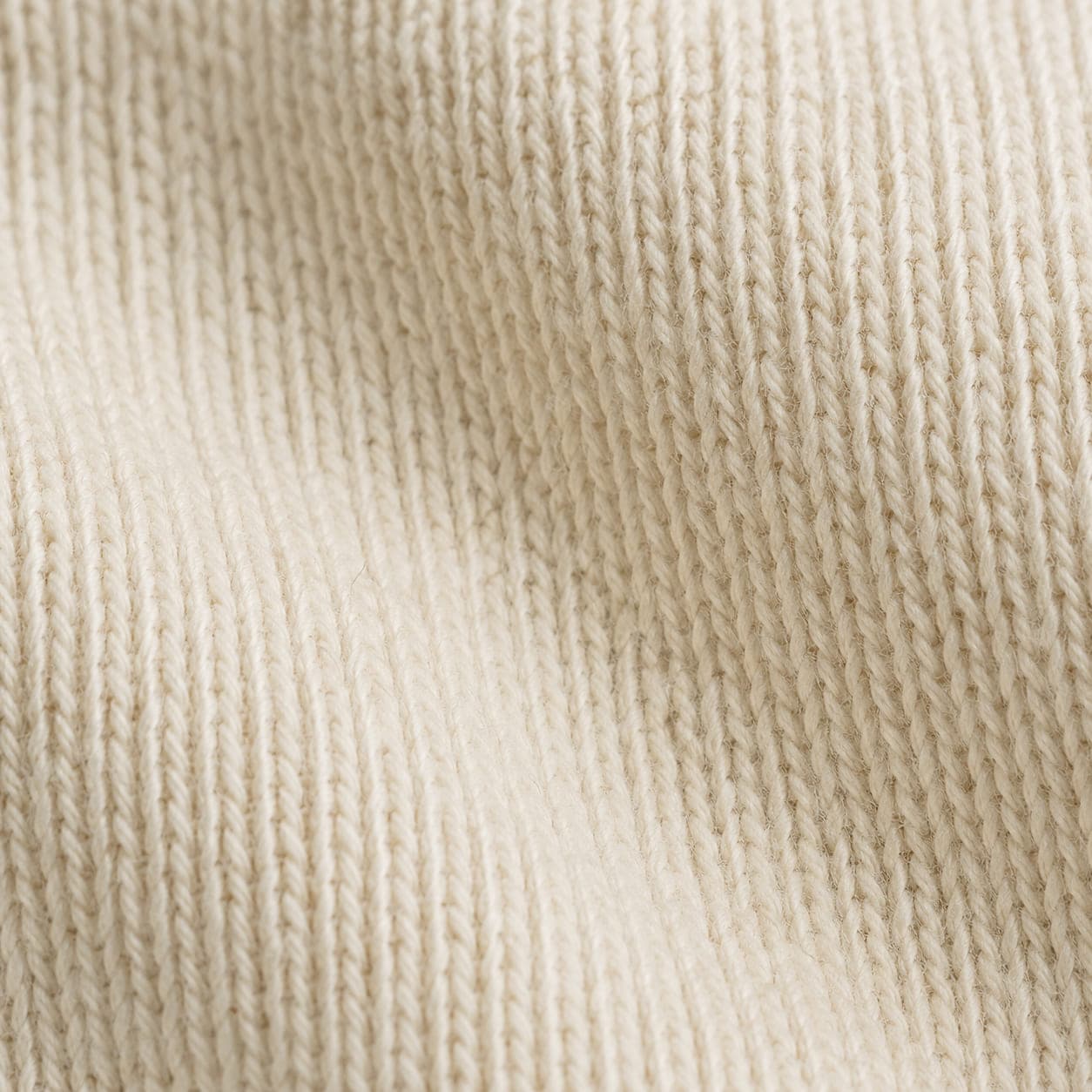
Plain single jersey
One set of needles, one continuous roll of fabric. Smooth on the face, looped on the back. Everything in lines A, B and most of C is built this way.
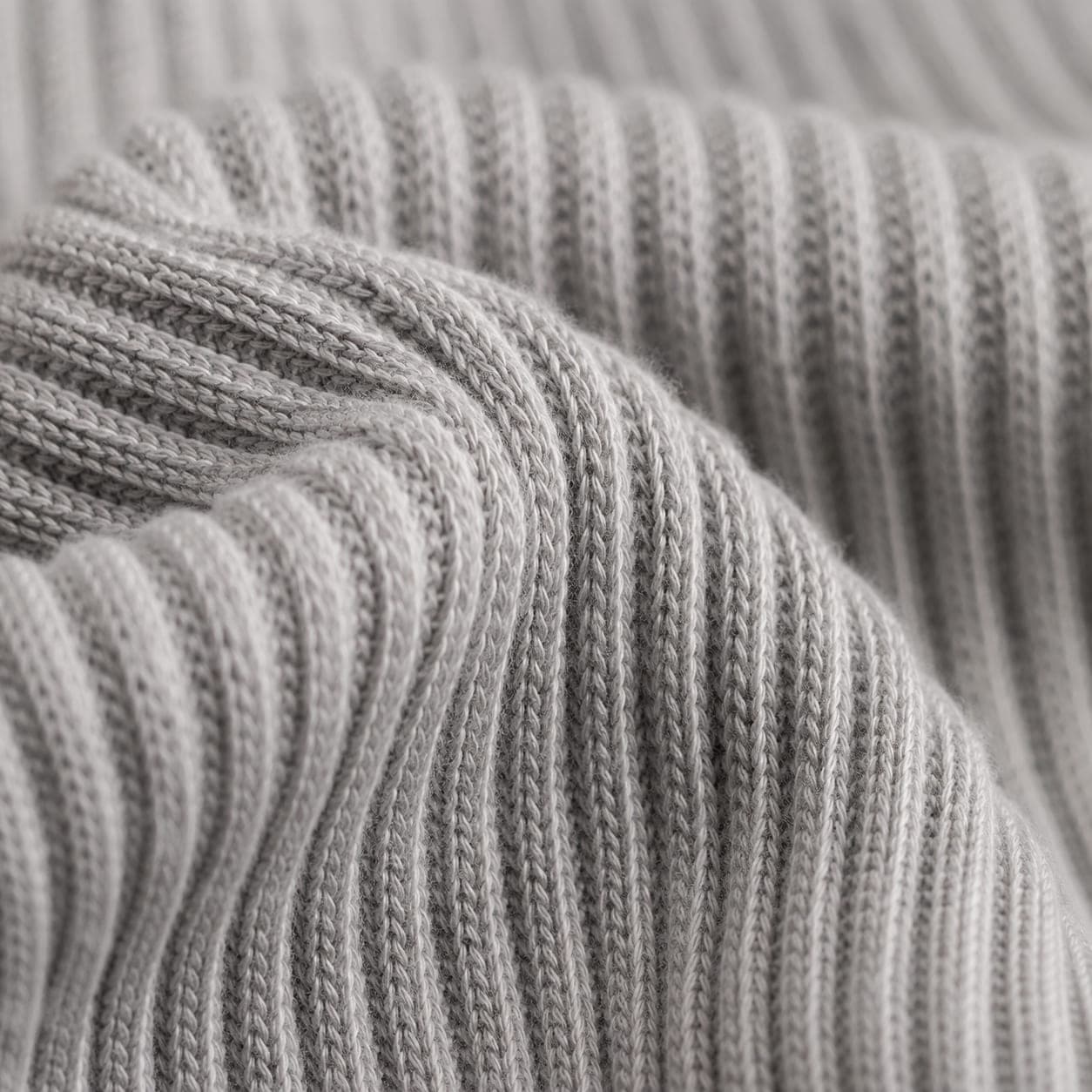
2×2 rib
Alternating columns pulled forward and back, so the fabric contracts across its width. It holds close to the body through structure rather than through elastane content.
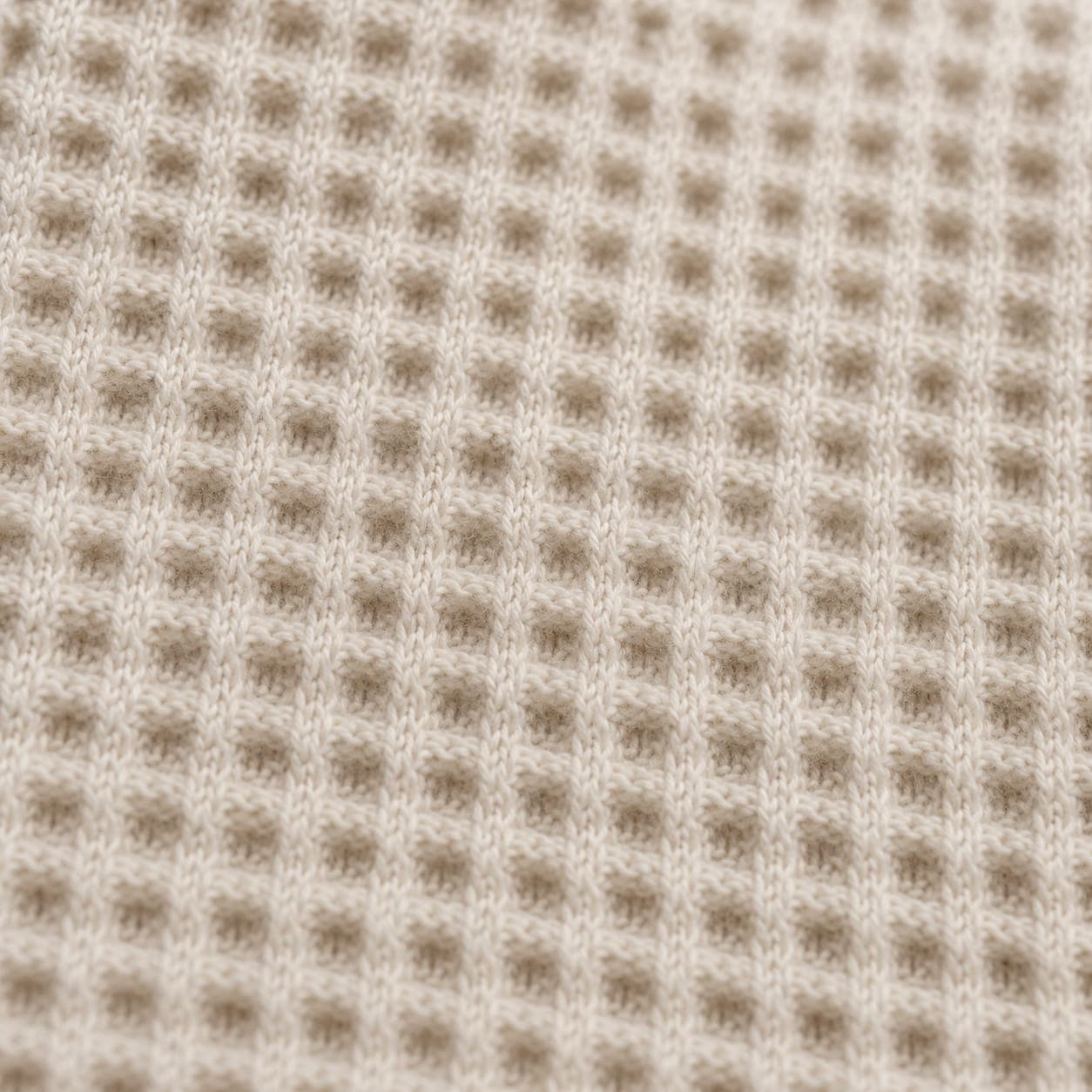
Waffle
A recessed grid that traps air between the skin and the layer above. Warmer for its weight — and the structure that moves most in the first wash.
Three yarns, and what each one costs you.
Every fibre we use trades one property for another. We would rather set the trade out than describe everything as soft.
Standard cotton
- What you gain
- Robust, predictable, the cheapest to replace.
- What it costs
- Shorter fibres mean more ends at the surface, so it fuzzes sooner than long-staple.
- Representative style
- Tee 160 Regular160 g/m² · $34
Extra-long staple cotton
- What you gain
- Longer fibres, fewer ends, the closed surface that holds up to abrasion.
- What it costs
- Roughly seventy per cent more than the same weight in standard cotton — Tee Pima 200 is $68.
- Representative style
- Tee Pima 200200 g/m² · $68
Modal blends
- What you gain
- The softest hand we stock and by far the most fluid drape.
- What it costs
- Measurably less durable: grade 3–4 against grade 5 for long-staple cotton.
- Representative style
- Long Modal155 g/m² · $58
What happens in the wash, and why we print it.
Knitted cotton relaxes and contracts the first time it is wetted, mostly in the direction it was knitted. This is physics, not a fault, and it is measurable — so we measure it.
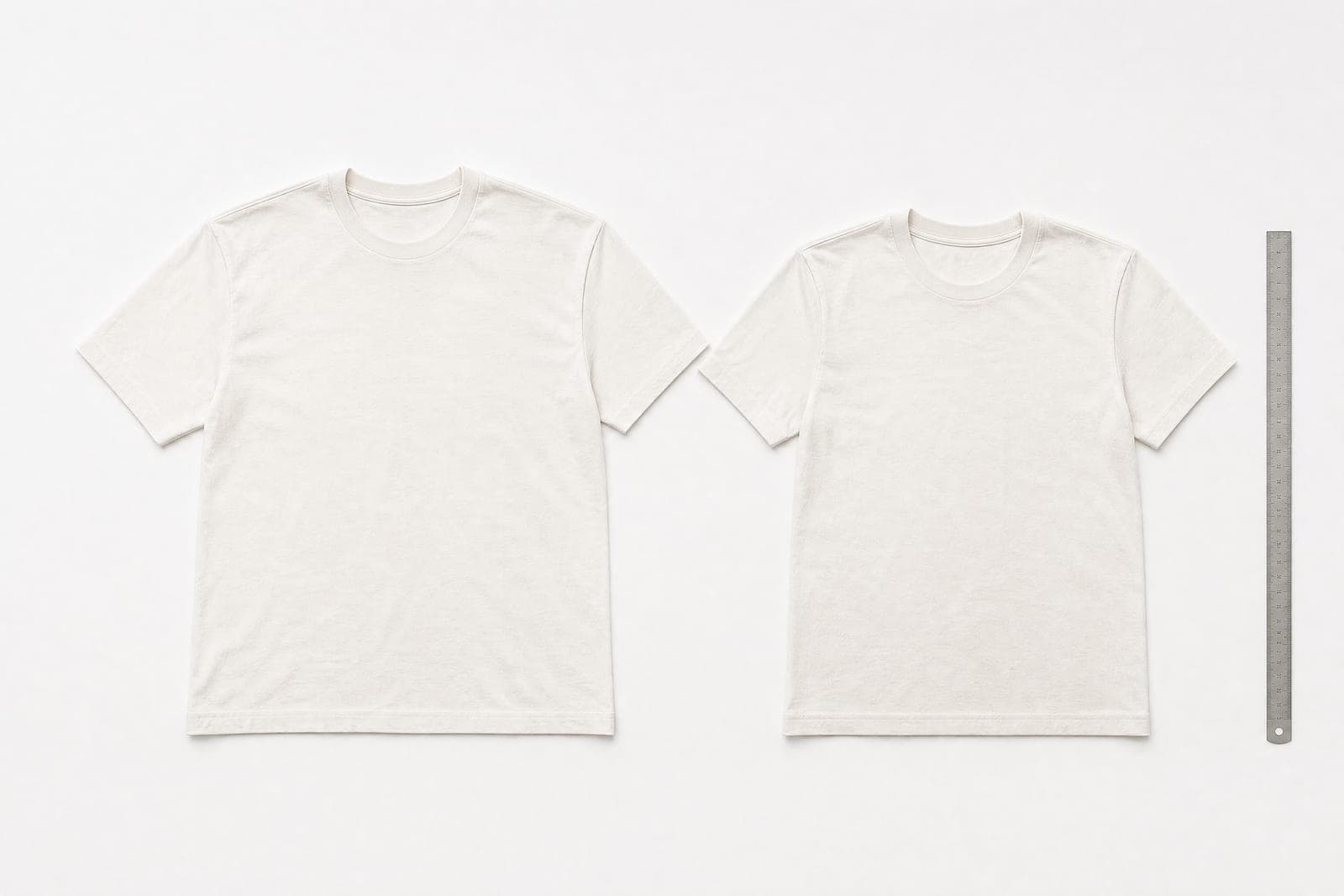
Shrinkage
We wash a production piece at 30°C, line dry it flat and measure it again. Length always moves more than width. The waffle structure moves most of all — Thermal Waffle loses 4% of its length — which is why every product page carries two size tables rather than one.
Tumble drying will take a piece further than the published figure. Our numbers assume you do not.
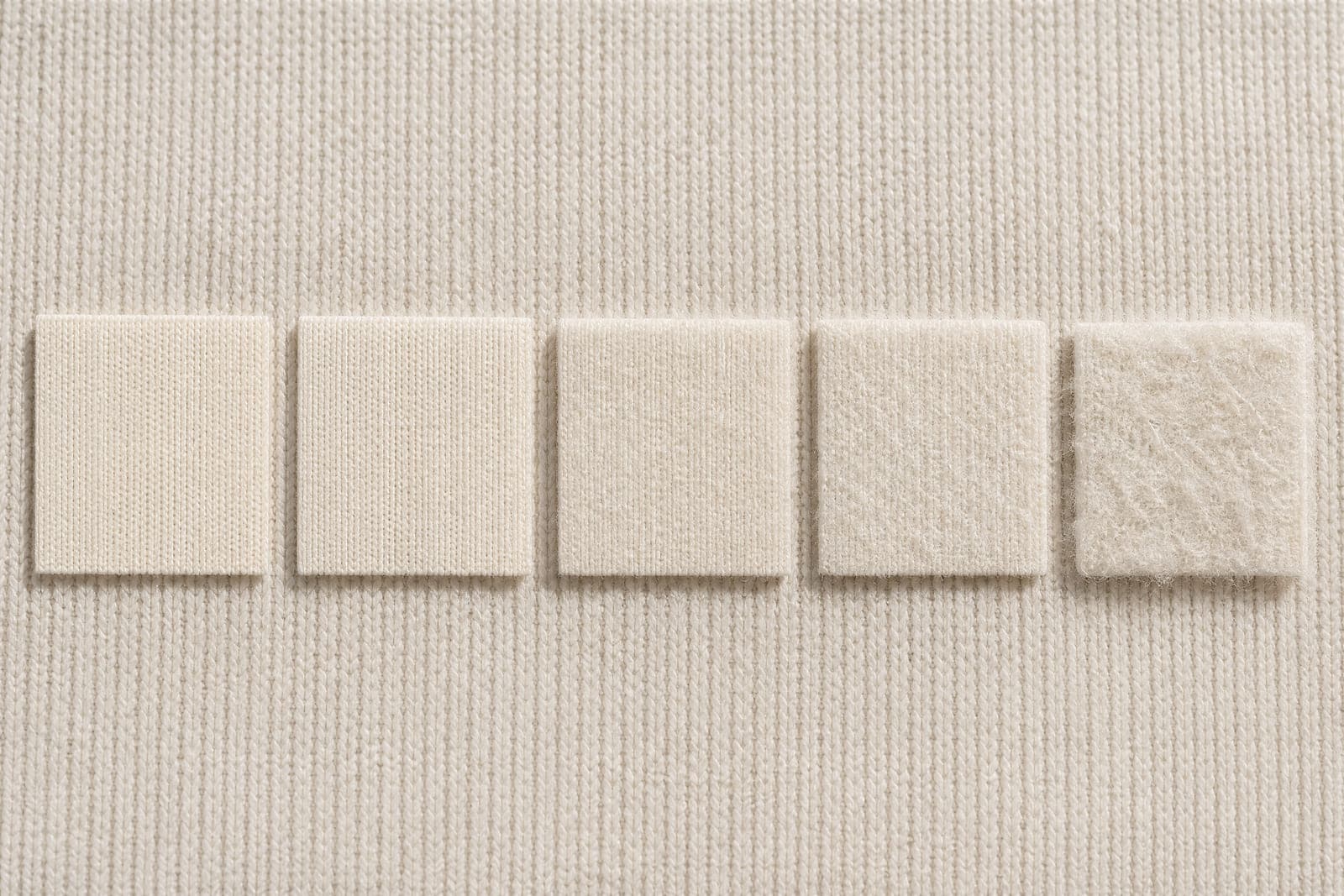
Pilling
Fibre ends work their way to the surface under friction and tangle into balls. A grade of 5 means the surface stayed smooth through the test; a grade of 3 means it did not. Because the number is meaningless without the test behind it, every grade we publish names its method and its number of cycles.
Where a style has not been through a completed test, the row is absent from the page rather than filled with an estimate.
Opacity
At or below 160 g/m² a pale plain jersey lets light through. Every style at that weight says so on its own page.Origin, stated twice
Where the fabric was knitted and where the garment was made up are different facts about different factories. Both appear on every product page.What we do not claim
We publish measurements, not performance. Where we hold no test data we say nothing at all: there are no health, hygiene or thermal claims anywhere on this site, and nothing we cut is a compression or body-shaping garment.Plain jersey is not shaped knit — and that boundary is deliberate.
A sweater is knitted to shape: each panel comes off the machine already the size of a front or a sleeve, and there is no fabric to cut. Plain jersey arrives as a roll, is cut to a pattern and sewn like cloth. Different machines, different sequence, different behaviour on the body. We build the flat-knitted layers and we do not pretend to build the other kind.